Traditional Digital Marketing vs AI-Powered Digital Marketing: Key Differences

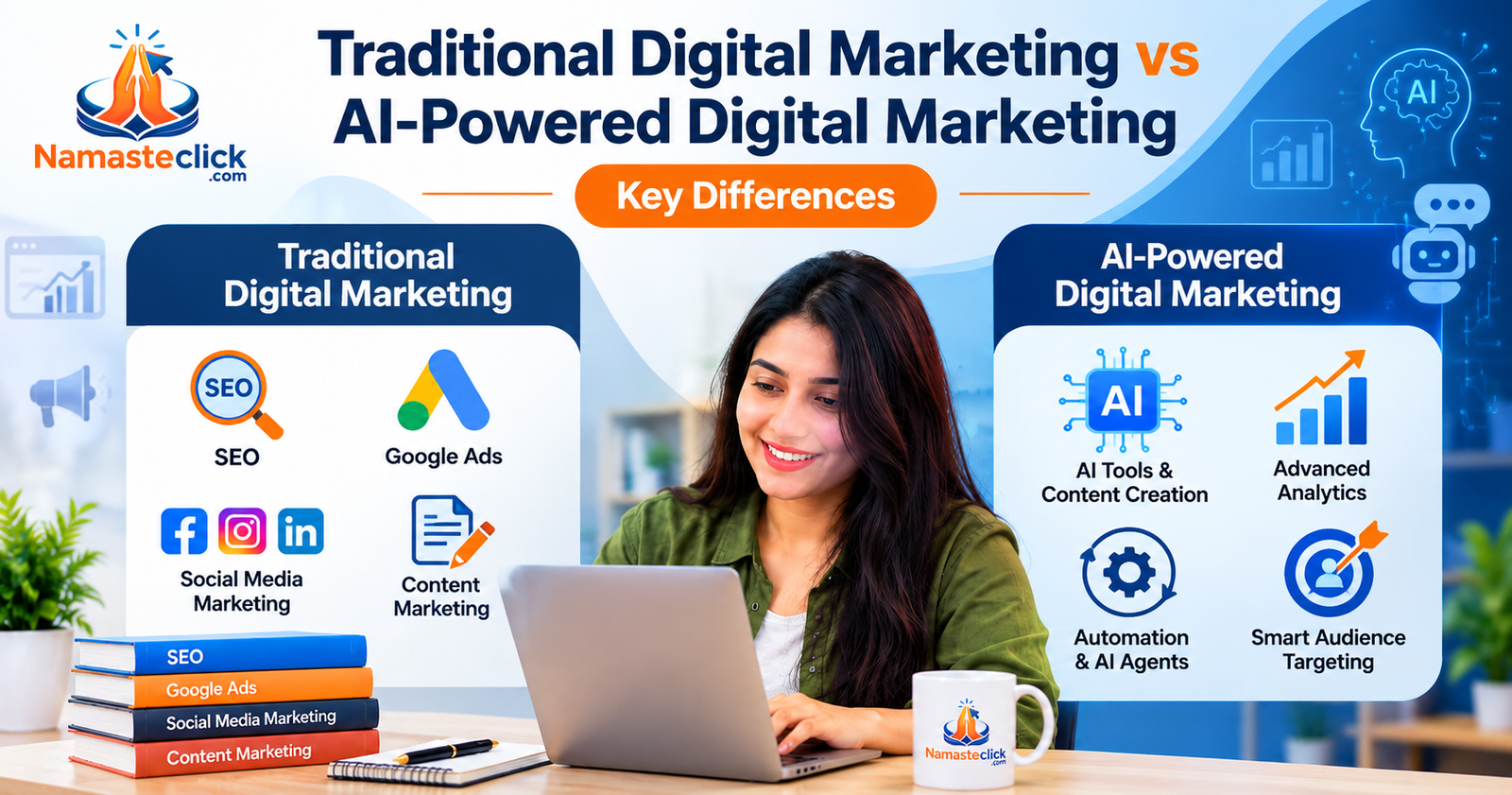
Traditional Digital Marketing vs AI-Powered Digital Marketing: Key Differences
Online marketing is changing fast. A few years ago, marketers did almost everything by hand. Today, Artificial Intelligence (AI) can research, write, test, and improve campaigns on its own. In this blog, we will understand both approaches in simple words and compare them point by point.
What Is Traditional Digital Marketing?
Traditional digital marketing means the well-known online methods used for many years. These include SEO, email marketing, Google Ads (PPC), social media posting, content marketing, and banner ads.
In this method, humans do most of the work. A marketer finds keywords, writes content, designs creatives, schedules posts, and studies reports to decide what to do next. Tools help a little, but mostly with small tasks like scheduling emails.
Simple example: A shopkeeper who personally talks to every customer and decides what to sell based on his own experience.
What Is AI-Powered Digital Marketing?
AI-powered digital marketing uses machine learning, predictive analytics, chatbots, and generative AI to run campaigns. The system learns from data, spots patterns, and keeps improving results automatically. The human role changes from doing every task to setting the strategy and checking the output.
Simple example: A smart assistant who remembers every customer’s choices and shows each one exactly what they are likely to buy.
How the Two Work: A Quick Diagram
Traditional marketing
Research by hand
Create content manually
Publish and wait
Check report, fix later
AI-powered marketing
AI studies live data
AI drafts and personalizes
Publish and test many versions
AI adjusts automatically
Traditional marketing waits for a report before making changes. AI-powered marketing learns and adjusts all the time.
Key Differences, Point by Point
1. Data Analysis
TraditionalYou run a campaign, wait for the report, and then decide what to change. A person can only study a limited amount of data.
AI-poweredAI reads huge amounts of data in seconds. It can notice that people on mobile phones who browse at night are more likely to buy. You plan ahead instead of only looking back.
2. Personalization
TraditionalUsually means adding the customer’s first name to an email or sending different messages to broad groups like “new customers” and “old customers.”
AI-poweredEvery person can get a different experience. AI changes product suggestions, email content, send time, and ads based on each person’s behavior.
3. Content Creation
TraditionalEvery blog, ad, and caption is written and designed by a person. Quality can be very good, but output is limited by team size and time.
AI-poweredAI writes drafts, suggests headlines, creates product descriptions, and turns one article into many formats within minutes. Humans must still edit for brand voice, facts, and originality.
4. Testing and Optimization
TraditionalA/B testing is slow. You test one or two things, wait for the result, and then apply the winner.
AI-poweredAI tests many combinations of headlines, images, and audiences at once, and moves the budget to the best performer automatically. Google’s Performance Max and Meta’s Advantage+ are good examples.
5. Customer Support
TraditionalSupport works during office hours and depends on human agents. Replies can be slow during busy periods.
AI-poweredChatbots answer common questions instantly, 24/7. They collect lead details, book appointments, and pass difficult cases to a human.
6. Predictions
TraditionalForecasts are based on past trends and simple calculations.
AI-poweredAI predicts which leads will buy, which customers may leave, and how much a customer may spend over time. Teams focus on the right people.
7. Speed, Scale, and Cost
TraditionalTo do more work, you hire more people, so costs rise.
AI-poweredTo do more work, you add more computing power, which is usually cheaper per task. Reports that took days can take minutes. But AI tools have subscription costs and need good data and some training.
Comparison Chart
| Point | Traditional | AI-Powered |
|---|---|---|
| Decision-making | Experience and past reports | Live data and predictions |
| Data handling | Limited, manual | Huge amounts, automatic |
| Personalization | Group-based | One-to-one |
| Content | Written and designed manually | AI-assisted, then human-edited |
| Testing | Slow A/B tests | Continuous multi-version tests |
| Customer support | Office hours | 24/7 chatbots |
| Forecasting | Simple trends | Predictive models |
| Scaling | Needs more people | Needs more data and tools |
| Speed | Days or weeks | Minutes or hours |
| Best strength | Creativity and human touch | Speed and accuracy |
Where Traditional Marketing Is Still Better
AI is powerful, but it cannot replace people completely.
- Creativity and emotion: Big brand ideas, storytelling, and humor come from human thinking.
- Relationships: Trust is built through real conversations, networking, and community.
- Cultural understanding: Humans understand sensitivity, context, and local culture better.
- Small or new businesses: With very little data, AI tools may not perform well.
Challenges of AI-Powered Marketing
- Data privacy: Laws like GDPR and India’s Digital Personal Data Protection Act require careful use of customer data.
- Over-dependence: Trusting AI blindly can lead to mistakes or boring, generic content.
- Bias: If the data is flawed, the results can be unfair or inaccurate.
- Skill gap: Teams need to learn how to use AI tools properly.
The Best Approach: Use Both
Smart marketers do not choose one over the other. They combine them. Let AI handle data analysis, audience grouping, first drafts, ad optimization, and reports. Let humans handle strategy, creativity, brand voice, quality checks, and customer relationships.
How to start
- List the repetitive tasks in your current work.
- Try one AI tool first, such as an email tool or a writing assistant.
- Compare the results with your old method.
- Always review AI output before publishing.
- Expand slowly to other channels once you see results.
Final Thoughts
Traditional digital marketing built the base: the channels and ideas that still work today. AI-powered digital marketing adds speed, accuracy, and personalization on top of that base.
The real difference is not only technology but also the way of working. Traditional marketing follows plan, execute, then analyze. AI marketing learns and improves as it goes. Businesses that mix AI’s speed with human creativity will be in the best position to grow.
The question is no longer “Should we use AI in marketing?” but “How wisely can we use it?”